
How to Quit Botox: A Complete Guide to Natural Alternatives
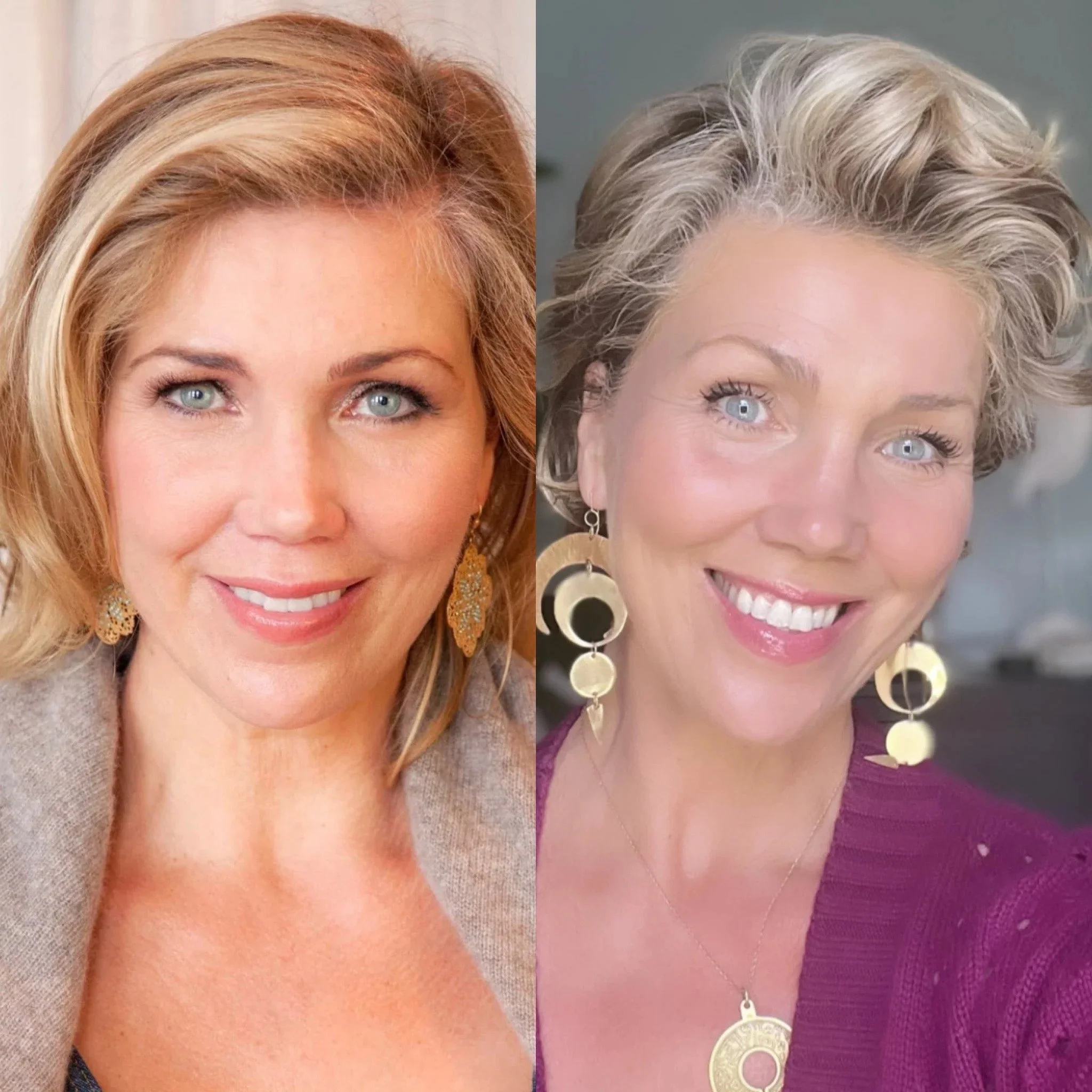
My 10 Year Before and After
The right side shows a decade of aging naturally, smiling freely, and restoring facial vitality without a single needle.
✨Why Quitting Botox Is More Than Just Skipping Your Next Appointment
Deciding to quit Botox is not just a cosmetic shift, it's a personal transformation of your identity
In this guide, I'll walk you through holistic alternatives, emotional insights, and practical steps to help you reclaim your natural beauty and radiance, without injections.
If you are looking for real Botox alternatives for women over 50, or searching for how to avoid a facelift naturally, this guide will give you the exact physical and emotional roadmap to reclaim your vibrant, expressive face.
✨Step-by-Step Guide to Quitting Botox
Have you noticed an overly shiny forehead or a raised eyebrow that doesn't look quite right?
Are you frustrated with how your smooth forehead doesn't match the rest of your face or concerned about potential side effects?
Or, maybe you're tired of shelling out $500 every few months for an expressionless look.
Whatever your reason for quitting, I'm here to help you stop using Botox and find balance with your natural beauty.
✨The Emotional Journey of Quitting Botox
Before diving into how to quit, it's essential to acknowledge that quitting Botox is more than just stopping injections—it's emotional.
When I quit Botox, I experienced a rollercoaster of feelings. The muscles in my face, once frozen, started moving again, and the emotions I had numbed began to thaw. I went through all the feels: sadness, fear, doubt, and eventually, joy.
Why quitting Botox brings up emotions:
When you freeze your facial muscles, you're also dampening your emotional expression. Research shows that facial expressions don't just reflect emotions—they help create them. When you can't furrow your brow in concern or crinkle your eyes in genuine joy, you're literally limiting your emotional range.
As the paralysis wears off, you may find yourself feeling things more intensely. This isn't a side effect—it's your natural emotional life returning. You might notice:
Sadness or grief about aging, or about the years you spent at war with your face
Fear about how you'll look without Botox, or what others will think
Doubt about whether you're making the right choice
Relief as tension releases from your face and body
Joy when you see your natural expressiveness returning
If you're considering quitting, be prepared to feel deeply.
I recommend EFT tapping, deep breathing, journaling, and somatic work to help process the emotions that come up.
Remember, this is about more than skin—it's about truly facing yourself.
For a deeper dive into my personal experience with quitting Botox, read my article Why I Quit Botox: It Was Aging My Face.
✨Create a New Beauty Blueprint With Your Self-Image
Think about building a house: would you start without a blueprint?
Your beauty journey is the same.
Instead of relying on products or injections, create a new beauty blueprint that aligns with your Higher Self.
What is a beauty blueprint?
Your beauty blueprint is the unconscious image you hold of yourself—the picture your mind uses as a reference point when you look in the mirror. Right now, that blueprint might be distorted by years of comparing yourself to filtered images, frozen faces, or beauty standards that don't exist in nature.
When you quit Botox, you have an opportunity to consciously redesign this blueprint. Instead of letting the beauty industry dictate what you should look like, you get to decide. This isn't about vanity—it's about alignment. When your external appearance matches your internal vision, you radiate authentically.
How to create your beauty blueprint:
Get quiet. Close your eyes and drop into your body. What does your future self look like? Not the you that's afraid of aging or chasing trends..the you that's fully expressed, confident, and alive.
Describe what you see. Is your skin glowing? Are your eyes bright? What's the quality of energy coming from your face? Don't focus on perfection, focus on vitality.
Write it down. Make this vision concrete. Your subconscious mind works better with clear instructions.
Revisit daily. Your blueprint isn't a one-time visualization—it's a living document that evolves as you do.
This plan becomes the foundation for how your face reflects your inner transformation.
✨Revitalize Your Self-Image: The First Step to Quitting Botox
Your self-image is the foundation of your beauty. Every thought, belief, and feeling is stored as an energetic imprint in your self-image. Quitting Botox starts with building a relationship with your self-image. This is where you begin to shift how you see yourself and, in turn, how others see you.
The mirror as a portal:
Most people avoid mirrors or use them as weapons—cataloging flaws, finding problems, reinforcing the story that they're not enough. When you quit Botox, you need to transform your relationship with the mirror.
The mirror isn't just reflecting light off your face. It's reflecting back the energy you're projecting. If you look in the mirror with criticism, you'll see things to criticize. If you look with love, you'll see beauty.
Spend time looking at your reflection—gently and without judgment. What do you love about your face? What brings fear or doubt? This process is not just about your skin; it's about facing YOU.
Mirror work practice:
Stand in front of a mirror for 3-5 minutes daily. Look into your own eyes. Notice what comes up—the urge to look away, the critical voice, the impulse to fix something. Don't act on these impulses. Just observe. Breathe. Stay present with your own face.
Over time, this practice rewires your nervous system's response to your own reflection. You move from judgment to neutrality to appreciation.
✨The Power of Visualization in Beauty Transformation
Visualization is the key to reprogramming your self-image. Seeing yourself with your eyes closed creates an inner image that can guide external changes. I've created a practice called Drifting and Dawning—a visualization technique for reprogramming your self-image during the most potent times of the day: right before sleep and as you wake up.
This is when your brain is most receptive to new patterns. Your brainwaves shift into alpha and theta states—the same states where hypnosis, deep meditation, and subconscious reprogramming happen naturally.
✨Drifting practice (before sleep):
As you're falling asleep, hold the image of your beauty blueprint in your mind. Don't force it—let it drift in gently. See yourself with glowing skin, bright eyes, natural expression. Feel the energy of this version of you. Fall asleep with this image.
✨Dawning practice (upon waking):
Before you fully wake, while you're still in that hazy state between sleep and consciousness, call up your beauty blueprint again. Let it be the first thing you see with your inner eye. Spend 30 seconds to a minute here before opening your physical eyes.
Use these moments to visualize the beauty blueprint you want to create.
Make this practice part of your daily beauty ritual.
Timeline: What to Expect When You Quit Botox
Understanding the timeline helps you navigate the transition with realistic expectations.
✨Month 1: The Thaw Begins
You'll start to notice subtle movement returning. The areas that were frozen will begin to soften. You might feel tingling sensations as nerve signals reconnect with muscles. Some people experience mild discomfort as muscles "wake up."
✨Months 2-3: Expression Returns
This is when you'll see the most dramatic changes. Lines and wrinkles that were smoothed will gradually reappear. Your eyebrows may shift position as muscles regain their natural tone. You'll notice you can make facial expressions you couldn't before—raising your eyebrows, furrowing your brow, squinting in genuine laughter.
Emotionally, this can be challenging. You're seeing your "real" face again, possibly for the first time in years. Be gentle with yourself.
✨Months 4-6: Full Reset
By six months, all traces of Botox are gone. Your face has returned to its natural baseline. This is when you can truly assess what you're working with and decide on your long-term beauty strategy.
Many people are surprised to discover their face looks better than they feared—more alive, more themselves.
The Awakening: Celebrate the Return of Movement
When your last injection wears off, the muscles in your face will begin to move again. Celebrate this moment!
Your expressions are returning, and with them, the energy and flow that create true radiance.
Movement is life, and youthful energy comes from the inside.
✨Why movement equals youth:
Look at a child's face, or a young person in their twenties.
What makes them look youthful isn't the absence of lines—it's the quality of energy and movement. Their faces are alive. Expressions flow naturally. There's no hesitation, no self-consciousness, no frozen planes.
When you freeze your face with Botox, you create the opposite effect. Stillness reads as stiffness. Smoothness reads as artificiality. The very thing you're doing to look younger actually signals "I'm trying to hide my age."
As your face comes back to life, love and appreciate the miracle of movement, knowing that fresh energy is the secret to an ageless glow.
✨Celebrate these moments:
The first time you can raise your eyebrows in surprise
When you furrow your brow reading something confusing and feel the muscles engage
The natural crinkle around your eyes when you laugh genuinely
The ability to express your full emotional range through your face
These aren't signs of aging—they're signs of being fully human and fully alive.
✨Defining Your New Beauty Vision
You have the power to define your beauty.
What do you want to look like? Do you want a smooth forehead? A more lifted face?
Brighter, more radiant skin? It's okay to want these things.
The key is to achieve them without relying on injections. Take some time to get clear on your vision of beauty, because this is about aligning your external appearance with your internal desires.
✨Questions to guide your vision:
What specific features do I want to enhance?
What bothers me most about my current appearance—and is that actually mine, or conditioning?
If I could look any way I wanted, what would my face express?
What does "beautiful" mean to me, separate from what I've been told?
How do I want to feel when I look in the mirror?
Write down your answers. This becomes your roadmap for the practices, products, and techniques you'll use moving forward.
✨My Favorite Tools and Products for a Botox-Free Glow
To achieve a smooth, lifted look without injections, you'll need the right tools and products.
Here are some of my favorites:
Retinaldehyde: A gentler form of Retinol, perfect for rejuvenation without irritation. Unlike traditional retinol, retinaldehyde converts to retinoic acid in one step instead of two, making it both more effective and less irritating. Use it 2-3 times per week to promote cell turnover and collagen production.
Peptides (like Argireline): Help relax expression lines while supporting overall skin health. Argireline is sometimes called "Botox in a bottle" because it works by limiting the neurotransmitters that tell facial muscles to contract. The difference? It's topical, temporary, and doesn't paralyze—it simply softens.
Gua Sha: An ancient practice that promotes circulation and lymphatic drainage for healthy, glowing skin. Using a gua sha tool correctly (with proper technique and pressure) can sculpt, lift, and depuff your face naturally. The key is consistency—3-5 minutes daily produces visible results over time.
Self-Touch: Nothing beats the piezoelectric magic of fingers on the skin regularly. Your hands carry an electrical charge that activates cellular regeneration when you touch your face with intention. This isn't woo-woo—it's biophysics. Regular facial massage with your hands restores muscle tone, promotes circulation, and creates that "lit from within" glow.
LED Light Therapy: Red and near-infrared light penetrate deep into skin tissue to stimulate collagen production and reduce inflammation. Use an LED mask or panel 3-5 times per week for cumulative anti-aging benefits.
Facial Cupping: Small suction cups increase blood flow and stimulate collagen production. This technique can reduce the appearance of fine lines and create a natural "plumping" effect.
✨Crafting a Skin Wellness Regimen That Lights You Up
Your skin wellness regimen should honor your natural vitality, not fight against it.
Morning Routine:
Gentle cleanser
I AM RITUAL in the mirror, tapping your skin and making eye contact with yourself.
Peptide serum
Moisturizer
2-3 minutes of facial massage or gua sha
Evening Routine:
Double cleanse (oil-based, then water-based)
Retinaldehyde (2-3x per week)
Facial oil
Intentional self-touch—press into the hollows of your face, feel the bone structure, appreciate your features
Drifting visualization as you fall asleep
Weekly:
LED light therapy (3-5 sessions)
Facial cupping or deeper gua sha work
Mirror work session (5-10 minutes of conscious reflection)
Incorporating visualization, intentional products, and holistic tools into your beauty routine will help you transition away from Botox while maintaining glowing, healthy skin.
✨ Your Next Step: Protect Your Beauty in Just 60 Seconds
Quitting Botox is a beautiful, sovereign choice, but it can also feel a little scary as your face begins to wake up and move again.
You do not have to walk this path of reclaiming your natural reflection alone.
To help you navigate this transition with peace and confidence, I created a simple, potent tool: the Protect Your Beauty 60-Second Clarity Ritual.
It will help you decide exactly how you would love to look and feel when you look in the mirror.
✨FAQ: How to Quit Botox
How long does it take for Botox to completely leave your system?
Botox typically wears off completely within 3-6 months after your last injection. The exact timeline depends on your metabolism, the amount of Botox used, and where it was injected. During this time, you'll notice gradual changes as facial muscle movement returns.
What should I expect when I stop getting Botox?
When you stop Botox, your facial muscles will gradually regain the ability to move and contract. Lines and wrinkles that were smoothed by injections will slowly return to their natural state. You may also experience emotional shifts as your face becomes more expressive again. Movement returning to your face is a positive sign—it means energy and circulation are flowing naturally.
Will my face look worse after quitting Botox?
No. Your face will return to its natural baseline—the way it would have looked if you'd never started Botox. However, you may perceive it as "worse" because you've become accustomed to seeing your face artificially smooth. The key is reframing your relationship with your natural face and understanding that expression lines are normal and beautiful.
What are the best natural alternatives to Botox?
Natural alternatives to Botox include facial massage, gua sha, retinaldehyde (a gentler form of retinol), peptides like Argireline that relax expression lines, visualization practices to reprogram your self-image, and intentional self-touch to restore circulation and muscle tone. These methods work with your face rather than against it.
How can I prevent wrinkles without Botox?
Prevent wrinkles by maintaining facial muscle tone through regular massage and intentional touch, using quality skincare with active ingredients like retinaldehyde and peptides, staying hydrated, protecting your skin from sun damage, and most importantly, maintaining a positive relationship with your self-image. Real aging happens at the identity level—when you're at peace with your face, you age more gracefully.
Is quitting Botox cold turkey safe?
Yes, quitting Botox cold turkey is completely safe. There are no withdrawal symptoms or medical risks associated with stopping Botox injections. The only "symptoms" are emotional—you may need to process feelings as your face becomes expressive again and as you adjust to seeing your natural features return.
How do I deal with the emotional side of quitting Botox?
Use EFT tapping, deep breathing exercises, journaling, and somatic work to process emotions that arise. Many people find that Botox numbed not just their facial muscles but also their emotional expression. As movement returns to your face, suppressed emotions may surface. This is healthy and part of the transformation process.
Can I use topical products to replace Botox results?
While topical products can't replicate Botox's muscle-freezing effect, they can support skin health and minimize the appearance of lines. Retinaldehyde promotes cell turnover, peptides like Argireline help relax expression lines, and consistent use of quality skincare combined with facial massage can create a lifted, radiant appearance without injections.
